
Philadelphia Lawn Care Calendar (Zone 7a): Month-by-Month Plan — Irrigation, Mowing Height, Fertilization, Overseeding
August 28, 2025
Philadelphia Lawn Care Calendar (USDA Zone 7a)
This guide is tailored for Philadelphia and nearby suburbs (Zone 7a) and focuses on cool-season grasses: tall fescue and Kentucky bluegrass (KBG). It mirrors the timing blocks from our calendar matrix and adds exact rates, soil-temperature triggers, and risk-free "if/then" rules.
Golden rule: Do not combine pre-emergent and seeding in the same season. If you plan a fall overseed, skip the fall pre-emergent (or use a seed-safe approach like mesotrione per label). In spring, apply pre-emergent only after last fall's seedlings are well established (typically 8–12 weeks).
📋 Quick Navigation
Jump to any section:
- 🌡️ Quick Temperature & Rate Reference
- 📅 Download Your Calendar
- 📋 Annual Plan by Task
- 📅 Month-by-Month (Zone 7a, Philadelphia)
- ❌ Common Mistakes (and Fixes)
- ✅ Mini-Checklists
- ❓ FAQ
- 📚 Related Articles
- 🚀 Ready to Get Started?
Quick Temperature & Rate Reference
- Spring pre-emergent: apply before soil holds near 55 °F (13 °C).
- Seeding/overseeding: target 60–75 °F (16–24 °C) soil temps — late Aug through late Sep is ideal.
- Broadleaf herbicides: best at 50–85 °F (10–29 °C).
- Summer irrigation target: about 1″/week total (25 mm), mornings preferred.
- Mowing height (fescue/KBG): spring 3.0–3.25″, summer 3.5–4.0″, fall 3.0–3.5″.
📅 Download Your Calendar
Get the complete Philadelphia Zone 7a Lawn Care Calendar:
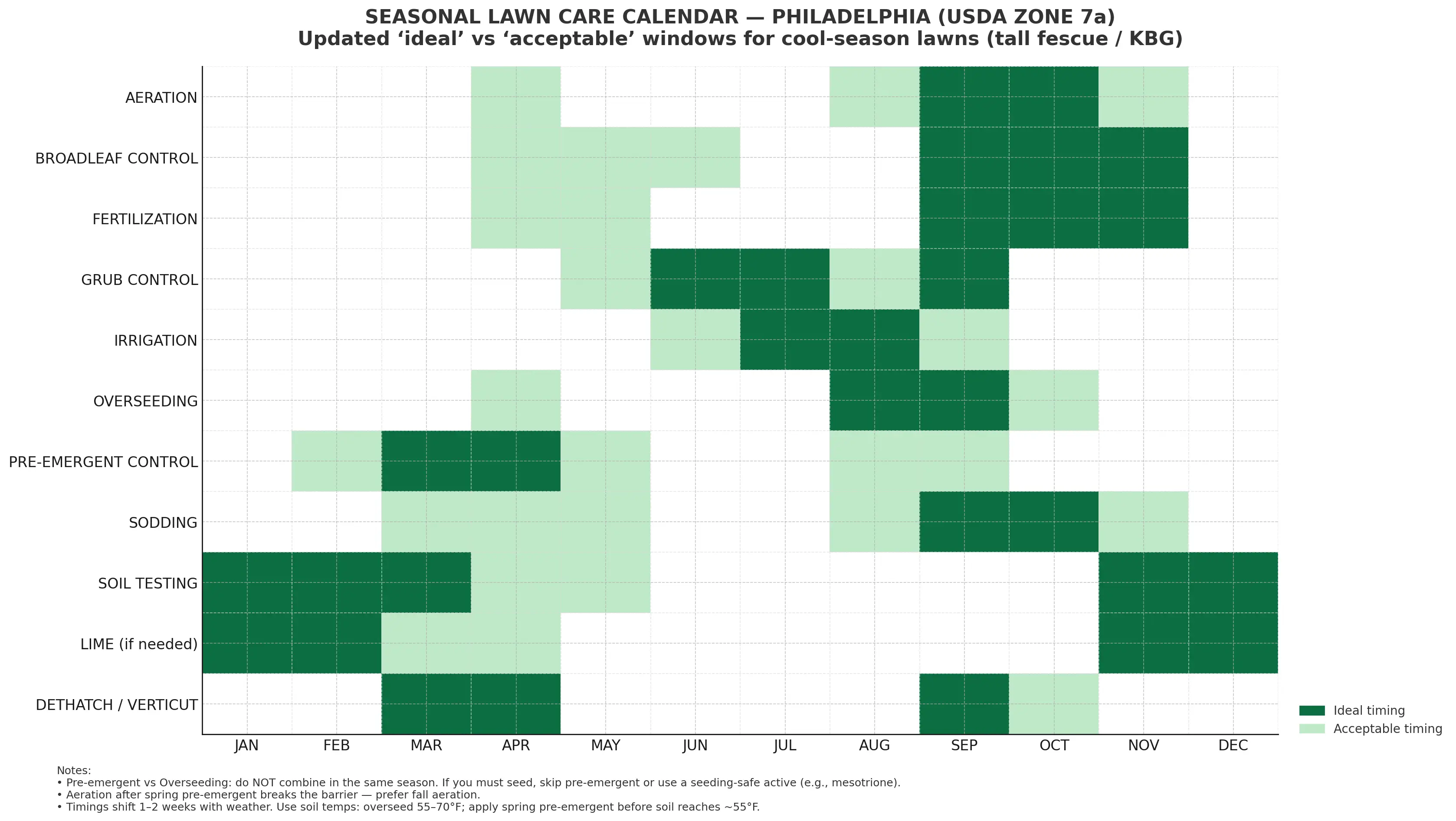
🔍 Click to zoom
Click the image above to view full size, or use the download link below:
- Download Calendar (WebP) - High quality, optimized for web
- Print-friendly version coming soon
Annual Plan by Task
Pre-emergent (crabgrass & annual weeds)
Primary window: March–April (split application recommended).
Optional fall window: late Aug–Sep for Poa annua only if you are not seeding.
- Spring: apply the first dose before 55 °F soil temp; a split follow-up 6–8 weeks later extends coverage through our long spring.
- Fall: consider only for Poa annua if no overseeding is planned.
- Avoid aggressive spring aeration right after you apply — it breaks the barrier.
Overseeding / Reseeding
Ideal: late August → late September; warm falls may allow into mid-October.
Rates (per 1,000 ft²):
- Tall fescue: 4–6 lb (≈ 200–300 g per 10 m²)
- KBG: 1–2 lb (≈ 50–100 g per 10 m²)
Tips
- Before seeding, reduce thatch (> 0.5″ needs dethatch), consider verticut and/or core aeration.
- Seed-safe mesotrione can help suppress weeds at establishment (follow label).
- Keep the top 0.5–1″ of soil consistently moist until seedlings root.
Core Aeration
Ideal: September–October.
Spring is acceptable only lightly and only when the pre-emergent barrier is not needed or already spent.
Two passes at perpendicular angles on slightly moist soil yields better plug density.
Dethatch / Verticut
Ideal: September; spring only gently. Fescues build less thatch, but use the 0.5″ threshold.
Fertilization (Nitrogen)
Fall carries the load:
- September: 0.75–1.0 lb N/1000 ft²
- October: 0.5–0.75 lb N/1000 ft²
- November (winterizer): 0.5–1.0 lb N/1000 ft² if turf is still actively growing
Spring: light touch only if turf shows need. Avoid N in summer heat.
Broadleaf Weed Control
Ideal: September–November (systemics perform best).
April–May is fine for spot-treatments. Do not spray >85 °F, and observe label intervals before/after seeding.
Grub Control (white grubs)
- April–May: chlorantraniliprole (early prevention).
- June–July: neonicotinoids such as imidacloprid/dinotefuran (prevention).
- August: curatives (e.g., trichlorfon) only if thresholds are confirmed.
Always water-in per label.
Irrigation
Deep and infrequent: aim for ~1″/week in hot spells.
- Calibrate with "tuna-can" tests.
- Water 5–9 AM. On clay, use cycle-soak (2–3 shorter cycles to prevent runoff).
Sodding
Best in spring or fall. Water daily the first week, then taper to deeper, less frequent cycles.
Soil Testing & Lime
Pull samples in late fall/winter. Lime only from test results (pH and buffer). Pelletized lime is easiest for even distribution.
Month-by-Month (Zone 7a, Philadelphia)
January–February
- Plan the season, service equipment, order a soil test kit.
- Watch for ice cover and salt injury along driveways.
March
- Pre-emergent #1 before soils hold ~55 °F.
- Light spring cleanup; first cuts at 3.0–3.25″.
- Spot-treat broadleaf weeds as weather allows.
April
- Pre-emergent #2 (split) 6–8 weeks after the first app.
- Sodding is viable.
- Light spring N only if turf is hungry.
May
- Prep for heat: raise mowing to 3.25–3.5″.
- Early grub prevention (chlorantraniliprole).
- Irrigate as needed.
June
- Neonic grub prevention per plan.
- Maintain 3.5–4.0″ mowing; shade areas toward the higher end.
- Pause N.
July
- Minimize stress: no aeration/dethatch.
- Morning irrigation; avoid waterlogging.
August
- Mid/late month: begin fall overseeding window.
- Prep: dethatch/verticut, core aeration if needed.
- If you seed — do not apply a fall pre-emergent.
September
- Prime month: overseed, aerate, begin fall nutrition.
- Optional light topdressing with sand/compost (thin layer).
October
- Nurture seedlings; second fall N.
- Excellent window for broadleaf control.
November
- Winterizer if soils aren't frozen and turf is still active.
- Mulch or remove leaves (don't smother seedlings).
- Final mow slightly lower than usual without scalping.
December
- Off-season: service equipment, pre-order seed/fertilizer.
Common Mistakes (and Fixes)
- Pre-emergent + seeding together: barrier blocks germination. Plan ahead or use seed-safe chemistry.
- Cutting too low in summer: increases heat stress and weeds. Use 3.5–4.0″.
- Frequent shallow watering: creates shallow roots. Water deeper, less often.
- Summer nitrogen: fuels burn and disease. Save N for fall.
- Aerating right after pre-emergent: breaks the barrier; follow the calendar.
Mini-Checklists
Pre-overseeding (1–2 weeks before):
- Measure thatch (remove if >0.5″).
- Map irrigation coverage.
- Seed on hand: fescue 4–6 lb/1000 ft², KBG 1–2 lb/1000 ft².
- Starter fertilizer ready; mesotrione if label allows.
Post-overseeding (0–4 weeks):
- Keep the top 0.5–1″ evenly moist.
- First mow at 3–3.25″ with a sharp blade.
- Avoid herbicides until label intervals are met.
Download the calendar
The calendar is now available at the top of this article for easy access.
Zone 7a timing can slide by 1–2 weeks with microclimates and yearly weather. When in doubt, follow soil temperature over wall-calendar dates.
FAQ
Can I apply a fall pre-emergent and overseed at the same time?
No. The barrier will block germination. Either overseed with a seed-safe program (e.g., mesotrione) or apply a fall pre-emergent for Poa annua — not both.
How much nitrogen should I apply in the fall?
For fescue/KBG in 7a, aim for ~2–3 lb N/1000 ft² total across 2–3 applications (Sep, Oct, and — if still actively growing — Nov).
What mowing height is best in summer?
Keep it at 3.5–4.0″, especially on hot, sunny or shaded lawns.
📚 Related Articles
Continue learning about Philadelphia lawn care:
-
🌱 How Much Does Lawn Mowing Cost in Philadelphia in 2025?
Get accurate pricing by neighborhood, lot size, and frequency. Learn how to save 10-20% on your lawn care. -
📏 How to Measure Your Lawn Square Footage (Fast) — Philadelphia Homeowner Guide
Three quick methods to measure your lawn: Google Maps, phone apps, and simple formulas. Perfect for getting accurate quotes.